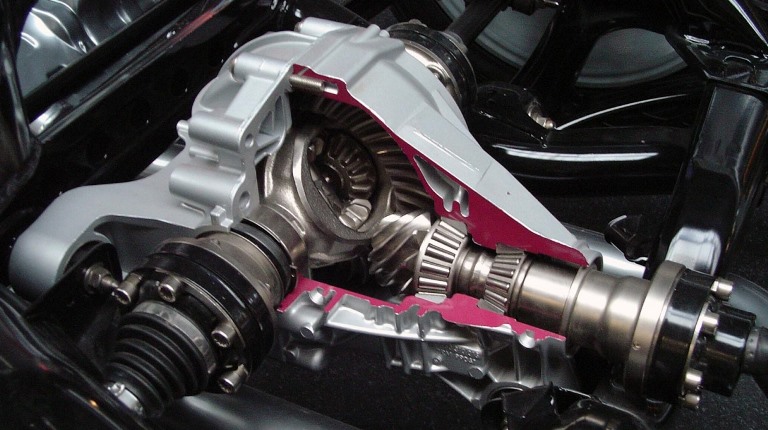
A rear differential should operate quietly enough that most drivers never think about it. When a steady whine appears during acceleration, deceleration, or at a certain road speed, it usually means something inside the gear set or bearing assembly is no longer operating the way it should.
The timing of the noise can provide useful clues. A whine that gets louder while you are on the throttle may point toward a different wear pattern than one that appears mainly when you lift off the accelerator. The sound alone does not identify the failed part, but it helps technicians decide where to focus their inspection.
How the Rear Differential Handles Power
The rear differential transfers torque from the driveshaft to the axle shafts while allowing the left and right rear wheels to rotate at different speeds during turns. Inside the housing, the pinion gear drives the ring gear, and the differential carrier distributes power to the wheels.
These gears operate under heavy load and need to mesh at very precise angles. Gear oil keeps a protective film between the teeth and lubricates the bearings that support the pinion and carrier. If gear position, bearing preload, backlash, or lubrication changes, the contact pattern can shift enough to create a noticeable whine.
Why a Whine During Acceleration Is Important
A noise that becomes strongest while accelerating is often associated with the drive side of the ring and pinion gears. Under throttle, engine torque loads the gear teeth in one direction. If the contact pattern is incorrect or the teeth are worn, that load can create a high-pitched humming or whining sound.
Possible causes include worn ring and pinion gears, incorrect pinion depth, excessive or insufficient backlash, or bearings that allow the gears to move under load. A differential that was recently rebuilt may also whine if the gear setup was not completed accurately.
A Whine During Deceleration Can Point Elsewhere
When you lift off the accelerator, the load on the gear teeth reverses. The coast side of the ring and pinion becomes more heavily loaded, which is why a differential can be quiet under acceleration but noisy during deceleration.
A coast-side whine can come from worn gear teeth, incorrect pinion position, excessive backlash, or bearing wear. Sometimes the sound appears only within a narrow speed range, such as between 40 and 55 mph. That does not make it harmless. Gear noise often becomes more noticeable as wear progresses.
Low or Contaminated Gear Oil
Differential gears and bearings depend on the correct quantity and type of lubricant. If the oil level drops because of a leaking pinion seal, axle seal, cover gasket, or housing, the gears may no longer receive enough protection.
Low oil increases friction and heat, which can damage bearings and gear surfaces. Contaminated or badly degraded oil can create similar problems. Metal particles in the lubricant are particularly important because they may indicate active internal wear.
Signs of a lubrication problem can include:
- Oil leaking around the differential housing
- Wetness near the pinion yoke
- A strong gear-oil odor
- Metallic particles in drained fluid
- Whining that becomes louder after longer drives
Adding fluid may protect the unit from further loss, but it will not reverse damage that has already occurred. The source of the leak still needs to be repaired.
Worn Pinion or Carrier Bearings
The pinion gear and differential carrier are supported by bearings that keep the gears in precise alignment. As those bearings wear, they can develop looseness or roughness that changes the way the ring and pinion contact one another.
Bearing noise is sometimes confused with tire or wheel-bearing noise because all three can change with road speed. Differential bearing problems may produce a whine, growl, or rumble, especially as load changes. Technicians may check pinion movement, rotational resistance, bearing preload, and contact patterns to determine whether the bearings are allowing excessive movement.
Incorrect Ring-and-Pinion Setup
Ring-and-pinion gears cannot simply be bolted together and expected to operate quietly. Pinion depth, backlash, carrier bearing preload, and tooth contact pattern all have to be set correctly.
A small setup error can produce noise even when the gears are new. Too much or too little backlash changes where the teeth meet. Incorrect pinion depth moves the contact pattern toward the face, flank, toe, or heel of the gear tooth. Under load, those differences can become an obvious whine.
This is one reason differential rebuilding requires specialized measuring tools and experience. Replacing gears without setting them correctly can leave the vehicle noisier than it was before the repair.
Can Tires or Wheel Bearings Sound Like a Differential?
Yes. Aggressive tire tread, uneven tire wear, and failing wheel bearings can all create humming noises that travel through the body and seem to come from the rear differential.
Tire noise often changes with pavement type, while wheel-bearing noise may change when the vehicle is gently steered left or right and weight shifts across the axle. Differential noise tends to respond more directly to throttle position and driveline load.
An inspection should separate these possibilities before the differential is opened. Road testing, listening equipment, fluid inspection, and checking wheel bearings can prevent unnecessary internal repairs.
What Happens If You Keep Driving?
A light whine can remain stable for some time, but a growing noise should not be ignored. If bearing wear or incorrect gear contact is causing the sound, continued driving can further damage the ring and pinion teeth.
Once the gear surfaces become heavily worn, adjusting backlash or 4replacing a bearing may no longer be enough. The repair can expand into a complete gear set replacement or differential rebuild. Regular maintenance and timely fluid checks can help catch leaks and contamination before internal wear becomes severe.
Get Rear Differential Service in Riverside, CA, With Premier West Gears
Premier West Gears in Riverside, CA, can inspect rear differential noise, check gear oil condition, measure backlash, evaluate bearings, and examine ring-and-pinion contact patterns.
If your vehicle whines during acceleration or deceleration, contact us to schedule differential service before the noise develops into more extensive damage.