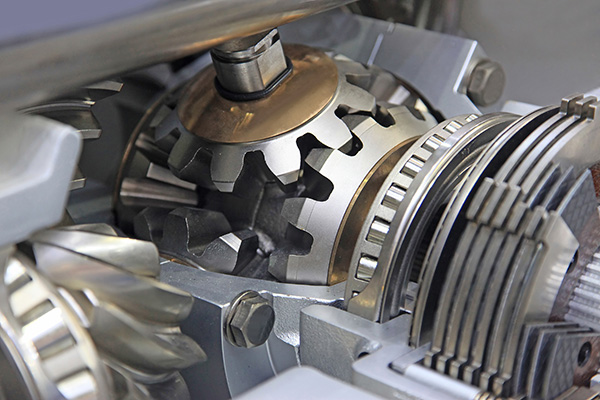
A transfer case does not get much attention until the vehicle stops acting like a real 4WD. Maybe it binds in a parking lot, grinds when you shift ranges, pops out of 4WD, or makes a howl that changes with speed. By then, the problem has usually been building for a while.
The transfer case is small compared with the engine and transmission, but it sits right in the middle of the drivetrain conversation.
If it is not doing its job, power does not get where it needs to go.
What The Transfer Case Actually Does
The transfer case sits behind the transmission and sends power to the front and rear axles. In a part-time 4WD system, the driver can choose between 2WD, 4HI, and 4LO. In other systems, it may use electronics, clutches, chains, gears, or sensors to automatically manage torque.
When it works correctly, the transfer case lets the vehicle handle loose dirt, snow, mud, steep climbs, and low-speed traction situations. It also has to disconnect or reduce the load when 4WD is not needed. That switching is where many problems begin.
Why 4WD Problems Often Start There
Drivers usually notice the symptom at the wheels, but the source can be farther upstream. A front axle may not engage because the transfer case is not sending power. A grinding noise may sound like it is coming from underneath the floor. A binding feeling may appear when turning, even though the issue is within the transfer case or in how it is being used.
This is why guessing gets expensive. The symptom might be a bad actuator, a stretched chain, worn bearings, low fluid, a bad encoder motor, a damaged shift fork, or even mismatched tires, forcing the driveline to fight itself.
A lot happens in that little case.
Low Or Dirty Fluid Is A Common Starting Point
Transfer case fluid has a rough job. It lubricates gears, bearings, chains, and internal moving parts while dealing with heat and load. When the fluid gets low, old, contaminated, or filled with metal debris, wear speeds up fast.
Some transfer cases have small leaks that never leave a dramatic puddle. The fluid can seep from an output seal, case half, plug, or vent area and spread across the underside. During regular maintenance, fluid level and condition are worth checking, especially on vehicles used for towing, off-roading, or frequent 4WD use.
Noises That Point Toward Transfer Case Trouble
Transfer case noises are usually tied to load, speed, or shift position. A whine that changes with road speed can point toward bearing or gear wear. A clunk when shifting into gear may involve mounts, driveshaft play, or internal slack. A grinding sound when selecting 4LO can mean the system is not fully engaging.
A stretched chain can create a skipping or popping sensation under load. Drivers sometimes feel it during acceleration in 4WD, almost like the drivetrain jumps for a split second. That is not a tire slipping. That is a mechanical clue.
Shifting Problems Between 2WD, 4HI, And 4LO
If the vehicle will not shift into 4WD, will not come out of 4WD, or gets stuck between ranges, the transfer case system needs attention. Older manual-shift systems can have linkage wear or issues with the internal shift rail. Electronic systems can experience encoder motor faults, switch problems, wiring issues, module failures, or actuator failures.
The pattern matters. Does it fail only when cold? Does the light flash but never finish engaging? Does 4HI work, but 4LO does not? Those details help narrow the inspection. We usually want to know exactly when the problem happens, because transfer case faults can be very specific.
Binding, Tire Scrub, And Mismatched Tires
Not every 4WD problem is a broken part. Sometimes the system is being forced to do something it was not designed to do. Part-time 4WD should not be used on dry pavement because the front and rear axles need to rotate at slightly different speeds during turns. If they cannot, the driveline winds up, and the vehicle feels like it is fighting itself.
Mismatched tires can create a similar problem. Different tread depths, sizes, or brands can change rolling diameter enough to stress the transfer case. On some vehicles, one wrong tire can keep the system loaded all the time. The first sign may be binding, hopping in tight turns, or strange noises after a tire replacement.
What We Check Before Blaming The Transfer Case
A transfer case diagnosis should include the parts around it. Driveshafts, U-joints, CV joints, axle engagement parts, mounts, tires, fluid level, wiring, and control modules can all cause symptoms that feel transfer-case-related.
Useful clues include:
- A noise that changes between 2WD and 4WD
- A flashing 4WD light that never goes solid
- Binding only during tight turns
- Fluid leaking near the output seals
- One tire newer or a different size than the others
A careful check keeps you from replacing the wrong part and still having the same 4WD problem.
Get Transfer Case Service In Riverside, CA, With Premier West Gears
If your 4WD is grinding, binding, leaking, popping, or refusing to shift ranges, Premier West Gears in Riverside, CA, can inspect the transfer case and the related drivetrain parts to find the real source.
Schedule a visit and get the system checked before one worn component starts dragging the rest of the drivetrain into the repair.